7 Best Loomly Alternatives in 2026 (After the Price Canyon)
Loomly killed its mid-tier plans and got acquired by Bending Spoons. Here are 7 honest Loomly alternatives for 2026, with real pricing, who each is for, and how to avoid the $49-to-$249 jump.
Loomly changed in 2025, and not in your favour
For years, Loomly was a genuinely nice tool. A clean content calendar, post-idea prompts, and one of the better approval workflows in the category, all at a fair mid-market price. If you’re reading this, you’ve probably noticed it isn’t quite that tool anymore.
Two things happened in 2025. Loomly restructured its pricing into two plans with a large gap between them, and it was acquired by Bending Spoons. Neither change is good news if you’re a small team, and both are why “Loomly alternative” is being searched a lot more this year.
One disclosure before we start: I build a competing tool (Social by InstantDM), so my own pick comes with a bias. I’ve kept the rest of the list honest, including where Loomly still wins.
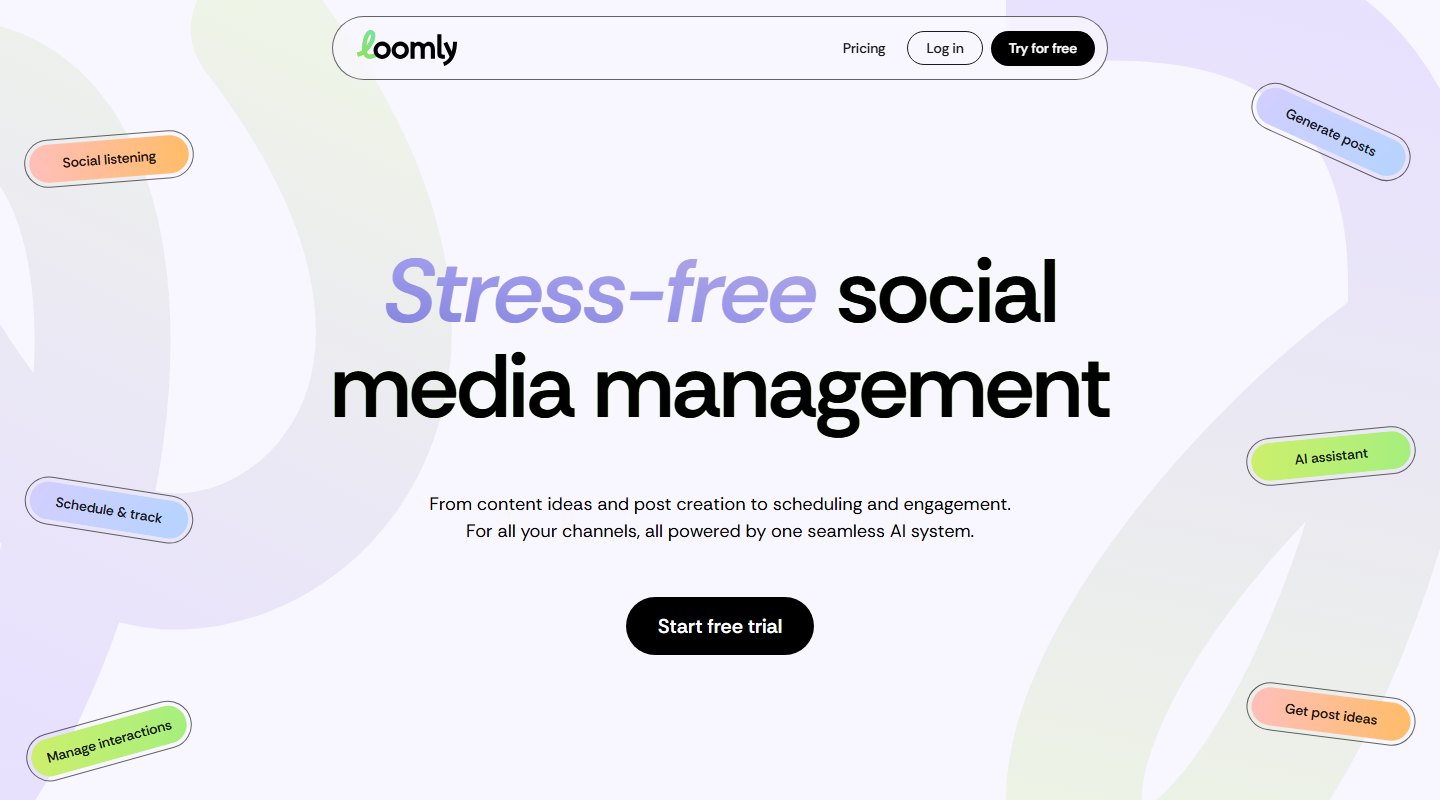 Loomly’s homepage today — “stress-free social media management.” The pricing is the stressful part now.
What actually changed (the two reasons people are leaving)
1. The pricing canyon
Loomly used to have four tiers, so you could grow through Base, Standard, Advanced and Premium as your needs did. In 2025 that got flattened into just two paid plans, and the result is what reviewers have started calling a pricing canyon.
- Starter: $65/month, or $49/month billed annually. 3 users, 12 social accounts.
- Beyond: $332/month, or $249/month billed annually. 60 accounts, unlimited users.
- Enterprise: custom.
There’s nothing in between. So the moment you add a fourth team member or a thirteenth social account, your only move is Starter to Beyond, which takes you from $49 to $249 a month on annual billing. That’s roughly a 5x jump, about 410%, for crossing a single line, as SocialPilot’s breakdown lays out. Growing businesses that were happily on a mid-tier plan effectively got priced out overnight.
There’s also no free plan anymore, just a 15-day trial.
2. The Bending Spoons acquisition
On 2 January 2025, Loomly was acquired by Bending Spoons, the Milan-based company that also owns Evernote, WeTransfer, Vimeo, Meetup and Eventbrite. In July 2026 it went public on Nasdaq and raised around a billion dollars to fund more acquisitions.
Here’s why Loomly users are nervous. Bending Spoons has a well-documented playbook: acquire an established product, cut costs hard, and raise prices. After it took over Evernote, the free tier was capped at 50 notes, and critics have described the broader approach as private equity on steroids. Nobody can tell you exactly what happens to Loomly’s pricing and roadmap next, but if you’ve watched this pattern before, the 2025 price restructure looks less like a one-off and more like a first move.
If vendor stability matters to you, that uncertainty is a fair reason to at least know your options.
How I’d choose a Loomly alternative
Given what’s driving people out, I’d weigh four things:
Look for pricing that scales smoothly, with no canyon between a cheap plan and an expensive one. Check whether adding a teammate or an account triggers a forced upgrade, because that’s the exact trap you’re leaving. Confirm it covers the platforms you post to and handles the collaboration or approval flow you rely on. And if the acquisition is what spooked you, weigh whether the vendor is independent or part of a roll-up.
With that in mind, here are the seven I’d point Loomly users to, ordered roughly by how well they fit Loomly’s typical buyer.
The 7 best Loomly alternatives in 2026
1. Social by InstantDM: no per-user cliff, and independent
My tool, so weigh it accordingly. The honest case for Loomly refugees is specific: it’s priced per account with unlimited team members on every plan, so adding a fourth or fifth person never triggers a jump. Pro is $19/month (about $120 a year annually) for 15 accounts, Max is $49/month for 20, and Ultra is $99/month for 50. Compare that to the Starter-to-Beyond leap and the difference is stark.
It publishes to 8 platforms, writes AI captions, and ships a public API and MCP server so an AI agent like Claude or ChatGPT can schedule for you. It’s also independent, part of InstantDM rather than a roll-up, if that’s part of why you’re leaving.
Where it isn’t the answer: it’s newer than Loomly, and it doesn’t match Loomly’s depth on post-idea generation or its most polished approval flows yet. Best-time-to-post is still on the roadmap. For a small team that wants to grow without a price cliff, though, it’s a strong fit.
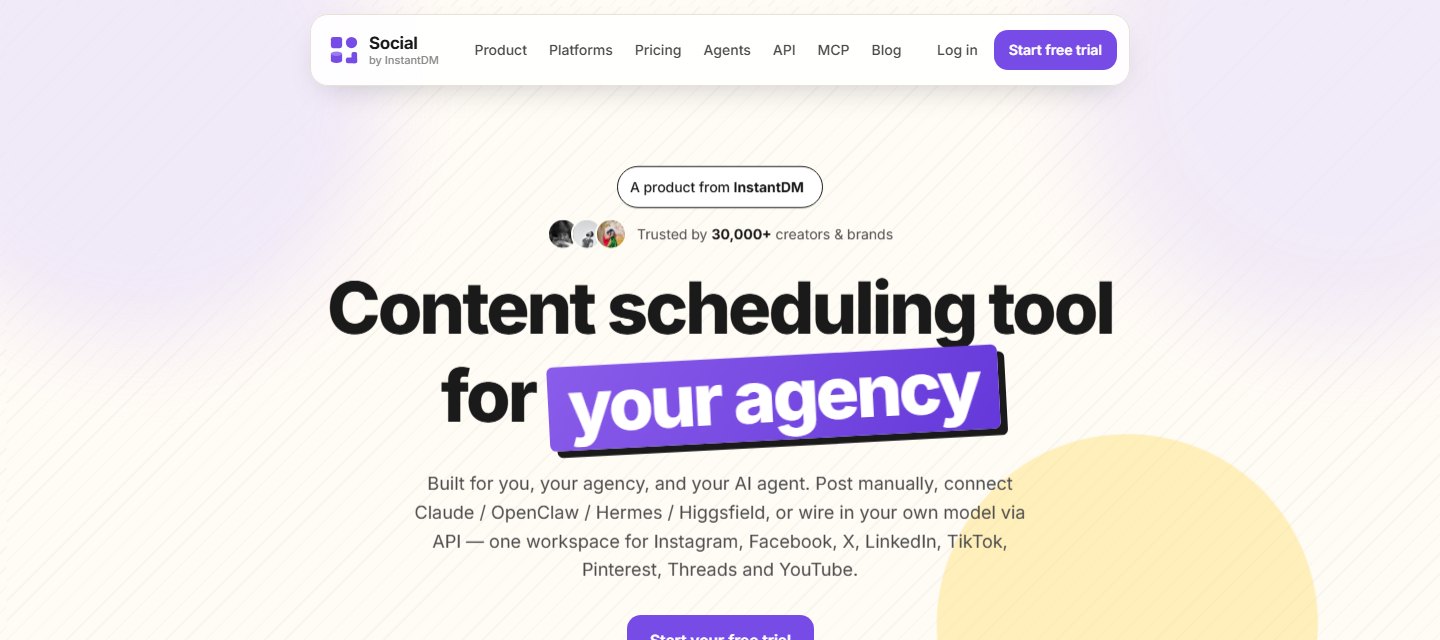
Best for teams that outgrew Starter and refuse to pay 5x for the privilege.
2. Planable: the closest match for approval workflows
If what you actually love about Loomly is the content review and approval flow, Planable is the most like-for-like replacement. It’s built around visual approvals, comments and sign-off, with a clean interface teams pick up quickly, and it’s priced per workspace rather than in giant tier jumps.
It’s lighter on analytics and listening than Loomly, so if you lean on those, factor that in.
Best for agencies and teams whose whole reason for using Loomly was collaboration and client approvals.
3. Metricool: cheap, and great for multiple brands
Metricool is the tool Reddit keeps recommending to people leaving pricier platforms. It pairs scheduling with strong analytics and competitor tracking, has a free plan, and starts around $18/month priced per brand, so it scales far more gently than Loomly’s two-step ladder.
Best for data-minded marketers and anyone managing several brands on a budget.
4. SocialPilot: built for agencies
SocialPilot targets the same agency buyer Loomly does, with bulk scheduling, client management and white-label reports from around $30/month. It’s less polished than Loomly in places, but you get the agency essentials without the Beyond-tier bill.
Best for freelancers and agencies managing multiple clients.
5. Buffer: if you just want simple
Buffer is the opposite of a feature-heavy suite. It schedules cleanly, still offers a free plan for 3 channels, and paid plans start at $6/month per channel. Analytics and collaboration are light, but for straightforward publishing it’s hard to beat.
Best for solo creators and small businesses who want simple over powerful.
6. Publer: the budget workhorse
Publer does a surprising amount for $12/month, including bulk scheduling, recycling and automation, with unlimited team members. A smaller integration library than Loomly, but excellent value.
Best for freelancers and startups who want a lot of tool for a little money.
7. Later: for visual, Instagram-first teams
Later is strongest for Instagram and TikTok, with a genuinely good visual calendar and Link in Bio, from around $25/month. Less compelling if X and LinkedIn are central to you.
Best for visual creators whose world is Instagram and TikTok.
What the alternatives actually cost (12 months)
The point of leaving Loomly is usually the jump, so here’s how a year looks once you cross the line that forces you onto Beyond.
| Scenario | Loomly | Social by InstantDM | Metricool | Buffer |
|---|---|---|---|---|
| Solo / small, ≤3 users, ≤12 accounts | Starter, ~$588/year | Pro, ~$120/year | ~$216/year | ~$216/year (3 ch) |
| 4th user or 13th account | Beyond, ~$2,988/year | Pro, ~$120/year | ~$216/year | scales per channel |
| Growing team, 20 accounts | Beyond, ~$2,988/year | Max, ~$250/year | ~$400/year | scales per channel |
Loomly figures are annual-billing rates from its pricing page. Social by InstantDM is per account/workspace with unlimited team members. Prices as of mid-2026; check each vendor for current numbers.
The middle row is the whole story. On Loomly, adding one teammate can take you from about $588 to $2,988 a year. On a per-account tool it doesn’t move at all.
Loomly vs Social by InstantDM, side by side
| Loomly | Social by InstantDM | |
|---|---|---|
| Free option | 15-day trial | 4-day trial |
| Entry price | $49/month (annual) | $19/month |
| Pricing model | Two tiers, big gap | Per account/workspace |
| Adding users | 4th user forces Beyond | Unlimited, every plan |
| Platforms | Major networks | 8 (incl. native YouTube) |
| AI captions | Yes | Yes |
| Public API + MCP server | No | Yes |
| Approval workflows | Strong (a real strength) | Basic |
| Ownership | Bending Spoons | Independent (InstantDM) |
When Loomly is still the right call
To be fair to Loomly, it’s still a capable product. The content calendar is polished, the post-idea prompts genuinely help when you’re staring at a blank page, and the approval workflow remains one of the best in the category. If your team lives inside that workflow, you’re already on Beyond and using it fully, and the price fits your budget, there’s no urgent reason to move.
The people who should look hard at alternatives are the ones about to cross the 3-user or 12-account line, or the ones uneasy about where a Bending Spoons-owned Loomly goes next.
How to switch off Loomly
It’s an afternoon’s work, not a project:
- Export your scheduled content and note your connected accounts in Loomly.
- Connect those accounts to your new tool, a few minutes each, via the official APIs.
- Rebuild your calendar and posting times.
- Move your team and any approval steps across.
- Run both in parallel for a week, then cancel Loomly before your term renews.
If the reason you’re here is that fourth teammate about to cost you five times as much, the fix is a tool that doesn’t charge for growth. Start a 4-day free trial of Social by InstantDM: 8 platforms, AI captions, unlimited team members, from $19/month. Weighing more options? Our best Hootsuite alternatives guide covers a lot of the same tools if Loomly isn’t the only one you’re reconsidering.
Frequently asked questions
Does Loomly still have a free plan?
No. Loomly has no free plan, only a 15-day free trial. Paid plans start at $65/month ($49/month billed annually) for the Starter plan.
Why did Loomly get more expensive?
In 2025 Loomly scrapped its four-tier structure (Base, Standard, Advanced, Premium) and left just two paid plans: Starter and Beyond. Because there's no mid-tier, growing past 3 users or 12 accounts forces a jump from $49 to $249/month billed annually, about a 5x increase.
Who owns Loomly now?
Bending Spoons acquired Loomly on 2 January 2025. Bending Spoons is the Milan-based roll-up behind Evernote, WeTransfer, Vimeo, Meetup and Eventbrite, and it has a reputation for raising prices after an acquisition.
What is the cheapest Loomly alternative?
Buffer ($6/channel) and Publer ($12/month) are cheapest for one person. For teams, per-account tools win: Social by InstantDM is $19/month with unlimited team members, so growing your team doesn't trigger Loomly's 5x price jump.
What is the best Loomly alternative for approval workflows?
Planable is the closest like-for-like for content review and approvals, which is Loomly's core strength. Social by InstantDM and SocialPilot also handle team collaboration at a much lower cost than Loomly's Beyond plan.
Is Loomly still worth it after the Bending Spoons acquisition?
If you use its content calendar and approval workflow heavily and the price works for you, it's still a capable tool. But if you're a small team likely to cross the 3-user or 12-account line, the forced jump to $249/month makes cheaper, smoother-scaling alternatives worth a look.