Faceless Content in 2026: Methods, Niches & Monetization: The Complete Guide
Faceless content in 2026 is a legit business. Here are the methods, niches, and monetization strategies that actually work.

TL;DR
Faceless content is creating and publishing social media content without showing your face. It uses AI voiceovers, stock footage, screen recordings, text animations, and voice-only narration instead of on-camera personality.
In 2026, faceless content is booming. Creators are earning $5,000-$50,000+ per month from faceless channels on YouTube, Instagram, and TikTok. The tools are better than ever. The opportunities are real.
Quick answer: a good scheduling tool such as Social by InstantDM helps you schedule and publish faceless content across platforms. The AI generates captions, hashtags, and content ideas, so you can focus on creation while it handles distribution.
Bottom line—faceless content isn’t about hiding. It’s about building a brand around content quality, not personal celebrity. This blog breaks down the methods, niches, and monetization strategies that work in 2026.
Introduction
There’s a persistent myth that you need to be comfortable on camera to build a real audience online. Walk through any “top faceless channels” list from the last year, and that myth falls apart fast—accounts pulling millions of views without a single frame of the creator’s face, built entirely on scripts, stock footage, and a consistent point of view. Faceless content isn’t a workaround for people who don’t want to be seen. It’s become its own discipline, with its own tools, its own production systems, and its own monetization playbook.
This guide walks through what’s actually working in 2026: the formats that perform, the process for building a channel from nothing, the tools worth paying for, the mistakes that quietly kill reach, and the legal details creators tend to overlook until they get a copyright strike. Whether you’re testing your first faceless account or trying to scale one that’s already gaining traction, the goal here is to give you a real operating manual, not just a list of ideas.

Best Faceless Content Strategies That Actually Work in 2026
Faceless content works because it separates the creator from the content. The value comes from the information, entertainment, or inspiration — not from who’s delivering it.
Here are the strategies that actually work in 2026.
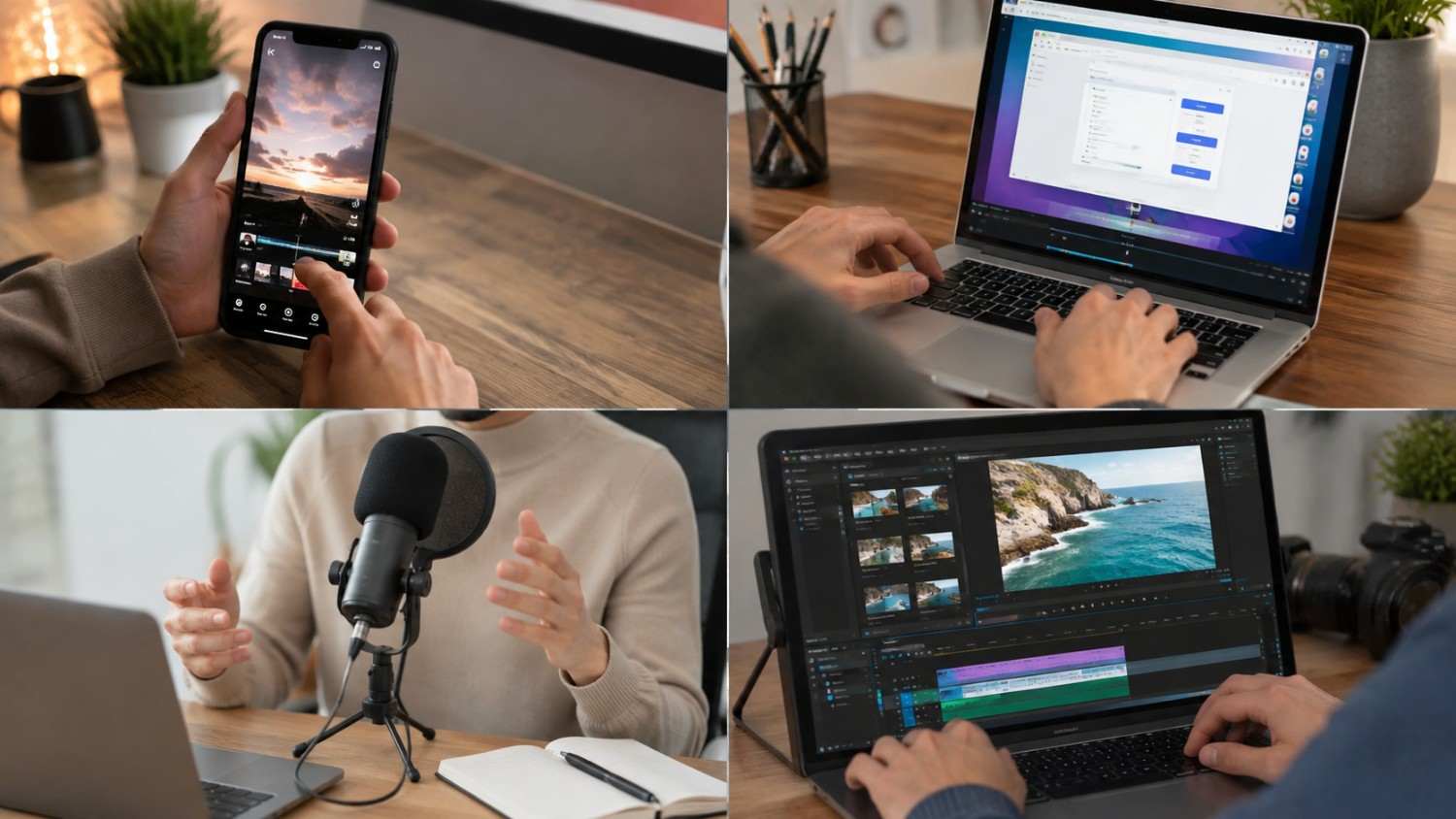
Narration-based content. You write scripts and use AI voiceovers or your own recorded voice. Stock footage, images, and animations provide the visuals. This works on YouTube, TikTok, and Instagram Reels.
Text-on-screen content. You put text over background footage. No voice needed. The text tells the story. This works well on TikTok and Instagram Reels.
Screen recording content. You record your screen while explaining software, tools, or processes. This works for tutorials, reviews, and educational content.
Compilation content. You compile clips, images, or information from multiple sources. Add narration or text overlays. This works for listicles, rankings, and educational content.
AI-generated content. You use AI tools to create scripts, voiceovers, images, and videos. This is the fastest-growing category in 2026.
A scheduling platform like Social by InstantDM helps you publish faceless content across platforms once it’s made. The AI generates captions and hashtags for each platform, and you schedule everything from one dashboard instead of logging into five separate apps.
How to Build a Faceless Social Media Brand From Scratch
Building a faceless brand requires a different approach than personal branding. Here’s the framework.
Step 1: Pick a niche. Choose a topic you can create 100+ pieces of content about. Check that the niche has audience demand.
Step 2: Define your content style. Will you use AI voiceovers or your own voice? Stock footage or original visuals? Text-heavy or image-heavy?
Step 3: Create your brand identity. Choose a name, logo, and color scheme. Make it consistent across all platforms.
Step 4: Build your content system. Create templates for scripts, thumbnails, and captions. This speeds up production.
Step 5: Start posting. Commit to 3-5 posts per week. Consistency matters more than perfection.
Step 6: Analyze and adjust. After 30 days, look at your analytics. What’s working? Double down on it.
The key difference from personal branding: your faceless brand is about the content, not you. Your brand identity comes from your style, your niche, and your quality — not your personality.
Choosing a Niche That Lasts
The single biggest predictor of whether a faceless channel survives its first six months is niche selection, and most people rush this step. A good faceless niche has three things: enough sub-topics to fuel a hundred videos without repeating yourself, an audience that’s actively searching for the information rather than just scrolling past it, and a gap where existing channels are either low-quality or inconsistent. Spend a week researching before you film a single clip — check search volume, watch what the top five channels in the space are missing, and write down twenty video ideas before you commit. If you can’t hit twenty ideas easily, the niche is probably too narrow.
Best Faceless Content Ideas for Instagram, TikTok & YouTube
Here are the content ideas that perform best across platforms.
Instagram faceless ideas:
- Motivational quotes over aesthetic backgrounds
- Before-and-after transformations
- Product showcases and unboxings
- Educational carousels with tips and facts
- Aesthetic lifestyle reels with text overlays
TikTok faceless ideas:
- “Did you know” fact videos
- List-format videos (top 5, 10 things)
- Story narration over relevant footage
- Screen recordings of apps and tools
- Comparison videos (this vs that)
YouTube faceless ideas:
- Documentaries and deep dives
- Top 10 lists and rankings
- Tutorial and how-to content
- Commentary and analysis
- Relaxation and ambient content
The common thread: these formats work without a face because they focus on information, visual appeal, or storytelling. Your personality comes through in your content choices, not your appearance.
How to Create Faceless Content Without Showing Your Face
Here’s the exact process I use.
Script writing. Use ChatGPT or Claude to generate first drafts. Edit for accuracy and add your unique angle. Don’t use AI scripts word-for-word.
Voiceover. Record your own voice or use AI tools like ElevenLabs or Murf. AI voices sound human enough for most content. Your voice adds authenticity.
Visuals. Use stock footage from Pexels and Pixabay. Use Canva for graphics and text overlays. Use screen recordings for tutorials. Use AI image generation for custom visuals.
Editing. Combine everything in CapCut, DaVinci Resolve, or Adobe Premiere Pro. Add music, transitions, and text animations.
Optimization. Write SEO-friendly titles and descriptions. Create custom thumbnails. Use relevant hashtags.
Once a piece is finished, distribution is its own job. Social by InstantDM helps you schedule and publish this content across platforms, with the AI generating platform-specific captions and hashtags so a script written for YouTube doesn’t get posted to TikTok word-for-word.

Best AI Tools for Faceless Content Creation
AI has transformed faceless content creation in 2026. Here’s a closer look at what each part of the stack actually does, since picking the wrong tool at any stage slows down the whole pipeline.
Script Writing Tools
ChatGPT and Claude both generate solid first drafts fast, and the real skill isn’t prompting — it’s editing. A raw AI script tends to sound generic because it’s trained to be broadly correct rather than specifically interesting. The creators who do well treat the AI draft as a skeleton: the structure and facts are usually right, but the hooks, transitions, and unique framing need a human pass before anything gets recorded.
Voiceover Tools
ElevenLabs currently produces the most natural-sounding AI voices on the market, with enough emotional range to carry a script without sounding flat. Murf is a solid budget alternative if you’re testing a niche before investing in premium tools, and Play.ht is worth a look specifically for voice cloning if you want a consistent narrator voice across a large content library without recording every line yourself.
Visual & Footage Tools
Pexels and Pixabay remain the best free sources for stock footage, and between the two you can usually find something usable for most narration-based content. Runway ML has become a real option for AI-generated video clips when stock footage doesn’t quite match the script, particularly for more abstract or futuristic topics where real footage simply doesn’t exist yet.
Editing Software
CapCut handles the vast majority of faceless content editing needs for free, with templates that make text animation and pacing far faster than building from scratch. DaVinci Resolve is the step up for creators who want more control over color grading and audio mixing without paying for Adobe’s subscription model, while Premiere Pro remains the standard for teams that need tight integration with other Adobe tools.
Thumbnail & Design Tools
Canva is fast enough to produce a clean thumbnail in under five minutes, which matters when you’re publishing several pieces a week. Photoshop is worth learning if your channel’s visual style needs more precision than templates allow, and Midjourney has become a genuinely useful way to generate unique thumbnail concepts that don’t look like every other channel in your niche.
The key insight: AI handles the tedious parts — scripts, voiceovers, thumbnails — so you can focus on strategy and creativity.
How to Build a Repeatable Faceless Content System
Systems create consistency. Here’s how to build one.
Document your process. Write down every step from idea to publish. This becomes your playbook.
Create templates. Script templates, thumbnail templates, caption templates. This saves hours per piece.
Batch your work. Don’t create one piece at a time. Write 5 scripts in one session. Record 5 voiceovers in one sitting. Edit 5 pieces in one batch.
Set quality standards. Define what “good enough” means for your channel. This prevents perfectionism from slowing you down.
Track your metrics. Views, engagement, follower growth. These numbers tell you what’s working.
Social by InstantDM helps with the publishing side of this system. Content ideas, captions, and hashtags come from the AI, the scheduler handles the actual posting, and you’re free to spend your time on creation and strategy instead of logging in five times a day.
The mistake I see most often: people try to create content one piece at a time. That’s exhausting. Batching saves hours and improves consistency.

Faceless Reels, Shorts & Carousels: What Performs Best?
Short-form faceless content is the fastest-growing category in 2026.
Reels (Instagram):
- Under 15 seconds performs best
- Loop naturally for higher watch time
- Text overlays with hooks work well
- Aesthetic visuals with music
- “Did you know” format gets high saves
Shorts (YouTube):
- 30-60 seconds is the sweet spot
- Educational content gets high engagement
- Story narration works well
- List-format videos get high watch time
- Tutorial clips drive subscribers
Carousels (Instagram):
- Educational carousels get high saves
- Before-and-after format performs well
- Step-by-step guides work great
- Tip collections get high shares
- Infographics drive engagement
The data is clear: short-form faceless content outperforms long-form in 2026. Start with Reels and Shorts. Add carousels for educational content.
Repurposing One Script Across Formats
The most efficient faceless creators don’t write a new script for every format — they write one solid script and cut it three ways. A 60-second YouTube Short can be trimmed down to a 15-second Reel hook, and the same core facts can be restructured into a five-slide carousel with almost no additional research. Treating each format as a separate content idea instead of a repackaging opportunity is one of the fastest ways to burn out on a faceless channel.
How to Grow a Faceless Account Without Losing Authenticity
Authenticity doesn’t require a face. Here’s how to maintain it.
Share your genuine opinions. Even without showing your face, your voice and perspective come through. Don’t be afraid to have opinions.
Use your own voice when possible. AI voices work, but your own voice adds authenticity. Record voiceovers instead of relying solely on AI.
Respond to comments. Engage with your audience. Answer questions. Thank people for watching. This builds connection without showing your face.
Share behind-the-scenes content. Show your workspace, your process, your tools. This humanizes your faceless brand.
Be consistent with your style. Your content style is your identity. Maintain it across all pieces.
Community management is where a lot of faceless creators fall behind, simply because it’s less visible than the content itself. Setting aside dedicated time each day to respond to comments — even a handful of thoughtful replies rather than dozens of generic ones — does more for retention than most creators expect, and tools that centralize comments and messages across platforms make that habit much easier to keep up.

Common Faceless Content Mistakes That Kill Reach
These mistakes destroy faceless channels.
Mistake 1: Choosing a saturated niche. Motivational quotes and generic life hacks are dead. Pick a specific, underserved niche.
Mistake 2: Sacrificing quality for quantity. 10 bad pieces won’t grow your channel. 5 good pieces will.
Mistake 3: Ignoring SEO. If your title and description don’t match what people search for, nobody will find your content.
Mistake 4: Bad thumbnails. Your thumbnail is your first impression. Invest time in making them click-worthy.
Mistake 5: Inconsistent uploads. The algorithm rewards consistency. Post on a regular schedule.
Mistake 6: Not watching your analytics. Your data tells you what’s working. Ignore it and you’re flying blind.
Mistake 7: Giving up too early. Most channels don’t see significant growth until piece 30-50. Commit to at least 50 pieces before judging results.
Mistake 8: Copying competitors exactly. Study what works, but add your own angle. YouTube rewards originality.
How to Recover From a Slow Start
If your first fifteen or twenty pieces haven’t taken off, resist the urge to abandon the niche entirely. Go back through your analytics and look specifically at retention graphs rather than view counts — a video that loses most of its audience in the first five seconds has a hook problem, not a niche problem, and that’s a fixable, specific issue rather than a reason to start over. Most slow starts are a production problem in disguise, not proof that the idea doesn’t work.
How to Monetize a Faceless Content Brand in 2026
Here’s how the money works.
Ad revenue. YouTube Partner Program pays $5-$45 per 1,000 views depending on your niche. Finance and tech channels earn the highest CPMs.
Sponsorships. Brands pay $200-$5,000+ per video depending on your audience size and niche.
Affiliate marketing. Promote products in your descriptions. Earn commissions when viewers buy.
Digital products. Create and sell ebooks, templates, or courses related to your niche.
Merchandise. Sell branded merchandise once you have a loyal audience.
Scaling strategies:
- Run multiple faceless channels in different niches
- Hire editors and script writers as you grow
- Repurpose content across platforms
- Build an email list from your audience
- Create a content library that compounds over time
For the repurposing piece specifically, a scheduler such as Social by InstantDM can help by letting you queue promotional content across social platforms to drive traffic back to your monetized channels, rather than manually posting the same promo on five different apps.
Diversifying Income Streams
Relying on a single monetization method is the most common reason established faceless channels stall out financially even while their view counts keep growing. Ad revenue fluctuates with algorithm changes and seasonal advertiser spending, so channels that also have an affiliate link, a small digital product, or a sponsorship pipeline tend to weather those swings far better. A reasonable target once a channel is established: no single income source should account for more than half of total monthly revenue.

Legal, Licensing & Ethical Considerations for Faceless Creators
This is the part of faceless content that gets skipped most often, and it’s the part that can actually shut a channel down.
Stock footage and music licenses matter more than people think. Free doesn’t always mean unrestricted—some libraries require attribution, some prohibit commercial use past a certain revenue threshold, and platforms are increasingly good at detecting unlicensed content through automated claims systems. A copyright strike on a monetized channel can wipe out weeks of work in a single takedown.
AI-generated voices and visuals bring their own set of open questions. Platforms are starting to require disclosure for content that’s substantially AI-generated, particularly video featuring synthetic faces or voices that could be mistaken for a real, specific person. Staying ahead of these disclosure requirements protects you from account penalties as the rules continue to tighten through 2026.
Using Stock Footage and Music Legally
Read the actual license terms of any footage or audio library before you build a channel around it, not after you’ve published fifty videos. Pexels and Pixabay generally allow commercial use without attribution, but always check the current terms since libraries do update their policies. For music specifically, YouTube’s Content ID system will catch mismatched licensing almost immediately, so it’s worth keeping a simple spreadsheet of exactly where each audio track came from and what its license allows.
Disclosing AI-Generated Content
Transparency isn’t just an ethical nicety here — it’s becoming a platform requirement. If a voiceover is entirely AI-generated, a brief note in the description or a small on-screen label costs almost nothing and protects you if a platform’s disclosure policy tightens later. Channels that build disclosure into their normal workflow from day one avoid the scramble of retroactively labeling hundreds of older videos when a new rule takes effect.
The Bottom Line
Faceless content in 2026 is a legitimate business model. It’s not about hiding. It’s about building a brand around content quality, not personal celebrity.
The creators who succeed treat faceless content like a real business. They pick specific niches. They create quality content. They build systems. They optimize for search. They play the long game.
A tool like Social by InstantDM can help with the publishing and promotion side once your content is made—generating captions, hashtags, and content ideas, and handling distribution—so you can spend more of your time on what actually moves the needle: creating content that provides real value.
Start today. Pick your niche. Create your first piece. Publish it. Then create another. That’s how faceless content businesses are built.