What Is a Content Pillar? Definition, Examples & 20-Minute Walkthrough
A content pillar is a core topic that anchors your content strategy. Learn the definition, see examples, and build yours in 20 minutes.

TL;DR:
A content pillar is basically a big idea that your brand keeps talking about. Blogs, reels, emails, tweets – whatever you share comes from it. Most creators who stay in the content game in 2026 have 3-5 pillars. You can work it in about 20 minutes with a pen and paper. Using tools like Social by InstantDM (https://socialbyidm.com) makes scheduling pillar-based content across 8 platforms a lot easier than doing it by hand.
What is a content pillar, anyway?
So, here’s the story. A content pillar is the main topic your brand keeps coming back to. This isn’t a one-off campaign or a single blog post. It’s the theme that you can see in everything you do.
Here’s how to look at it. Think of the content pillar as the one thing your brand always mentions when meeting someone at a party. “Oh, you do marketing? Yeah, I’ve been really into Instagram growth strategies lately.” That’s a pillar. They refer back to that pillar for everything they say.
A content pillar does the same thing for your business. You discover a topic your audience really cares about, and then you create a bunch of different content pieces from that one idea. Blog posts, Instagram carousels 5. YouTube clips. Email newsletters, and it all boils down to the pillar.
Here’s why that’s important. Without those pillars, you’re just posting random stuff hoping it hits somewhere. You have pillars. You have a system. You know what to say, who you’re talking to, and that every piece of content builds on the last.
Why should you care about content pillars in 2026?
Look, I understand. You’ve heard of content pillars before and thought, “That sounds like extra work.” I get it. But here’s what’s really different.
In 2026, social media algorithms are much smarter than they used to be. They don’t just count how many posts you’re publishing. They check to see if you consistently talk about the same stuff. Post about fitness on Monday, cooking on Tuesday and crypto on Wednesday, and the algorithm can’t understand what you’re about. So it’s not pushing your content out to anyone.
But if you post about fitness every single day (workout tips, nutrition advice, mindset stuff), the algorithm figures out, “Oh, this person is about fitness,” and starts showing your content to people who actually care about fitness.
That’s the first thing. Depth and consistency win in algorithms. Content pillars give you both of these.
The second is decision fatigue. I don’t know about you but I spend far too much time staring at a blank screen trying to figure out what to post. That is not an issue when you have pillars. You go to your pillar list, pick a topic and start creating. 30 seconds instead of 30 minutes.
Third thing. Repurposing. One pillar topic can be ten pieces of content. You write a blog post on “how to grow on Instagram”. You then turn that into an Instagram carousel. Then a thread on Twitter. Then a YouTube short. Then an email to your list. Same idea, 5 formats. That’s clever.
And the fourth thing no one talks about — the AI search. More and more people are asking for recommendations from Chatbot or Claude instead of googling. When those AI tools go looking for answers, they pull from content that shows deep expertise on particular topics. If your brand has strong pillars and a lot of content around them, you are much more likely to get cited.

What Are Some Successful Content Pillar Examples?
I’m not going to give you some abstract framework that sounds good on paper but doesn’t help in practice. This is what real businesses are doing.
An online clothing store may have:
- Outfit ideas & style tips
- Behind the Scenes Stories of Brands
- Customer reviews & photos
- Product rollouts
- Ethical sourcing and sustainable fashion
A SaaS company can have:
- Workflow tips and productivity hacks
- best practices for team collaboration
- Trends and data from the industry
- Success stories of our customers
- Tutorials to get you started
A personal trainer may have:
- Exercise form and workout routines
- nutrition and food preparation
Mindset & Motivation
- Before and after client stories
- Recommended gear and equipment
A restaurant in the area may have:
- Tips and techniques for cooking
- The source of your ingredients
- Seasonal features and menu highlights
- Kitchen culture and staff stories
- Local partnerships and community events
A social media teacher content creator may have:
- Tactics specific to each channel (Instagram, TikTok, LinkedIn)
- Tips on content creation (filming, editing, design)
- Analytics & Performance Tracking
- Business growth and monetisation
- Behind the scenes and personal stories
See the trend? Each pillar is large enough to hold tonnes of content but specific enough that you’re not rambling about random topics. There is not much overlap between these pillars.
Content Pillars & Social Media Strategy
Here’s something I learned the hard way. Content pillars and social media strategy aren’t two different things. They are one and the same. You get the topics. The other will give you the format and schedule.
Choice of Platform. Content preferences vary from platform to platform. Instagram is about visual carousels and Reels. LinkedIn is a fan of long text posts. TikTok is built around short-form video. Your subject matter is determined by your pillars. The platform will tell you what format to use.
Posting Schedule. Pillars allow you to maintain a consistent posting schedule. Content for Pillar 1 could be on Monday. Pillar 2 could be Tuesday. “Wednesday might be Pillar 3.” This rotation will keep your feed diverse, but also focused.
Content batching with pillars, you can create batches. You can sit down once a week and create five posts — one for each pillar — instead of creating one post at a time. Then spread them throughout the week. Much more efficient than doing it day by day.
Increase in the audience. When you constantly post the same stuff, the algorithm begins to show your stuff to people that like that stuff. This is how you build a community that really cares about what you say.
The relationship between pillars and social media strategy is simple: pillars give you the what, social media gives you the where, and a schedule gives you the when.

What are the benefits of content pillars for social media engagement?
Engagement is no accident. It follows templates. And content pillars help you leverage those patterns.
Consistent things are familiar. When you’re posting about the same things consistently, people start to see your brand. Trust comes from familiarity. Trust drives engagement. That’s easy.
Depth creates authority. One post on “Instagram tips” does not make an authority. But 50 Instagram tips posts in six months? That’s some serious building of credibility. People consume content from people that they know and trust.
Relevance Links. When your content speaks to their problems consistently, they feel like you get them. Understanding breeds loyalty. The loyalty leads to comments, shares and saves.
Its variety of formats keeps it fresh. You can vary the format of your content in each pillar: carousels, reels, stories, text posts, polls. This keeps your audience engaged, without any confusion about what you stand for.
The data supports this. Accounts that post regularly on 3 to 5 core topics have a 40 to 60% higher engagement rate than accounts that post on random topics. That is quite a difference. That is the difference between a dead account and a successful one.
What are the best ways to create effective content pillars for social media?
I’ll tell you the precise process I followed. A twenty-minute drive. No fancy equipment. Just me, my notebook and my phone.
Brain dump. 1-5 min. Make a list of all the questions your audience asks. Don’t you filter? No overthinking. Just let everything pour out of your head onto paper. Check out your DMs, comments, emails and customer service messages for ideas.
Minutes 6 to 10 – group similar stuff. Look at your list and circle things that go together naturally. “Instagram scheduling”, “best times to post” and “content calendar tips” all fall under one category. Another includes “how to write captions”, “hashtag strategy”, and “Instagram bio optimisation”.
Minutes 11 to 15 — score each team. Ask yourself three questions for each group: How well do I know this? How much does my audience care? 20+ content ideas can I come up with? Rate each one 1 through 3. Add up the points.
Minutes 16-18 – choose your best 3-5. The teams with the most points win. If 2 groups are very close, merge them into a broader pillar.
Minutes 19-20 - list them. Ensure that each pillar has a distinct name. “Social media growth” beats “all the stuff about growing online”. Simple beats clever.
That’s it. 20 mins. You have a framework.

How many content pillars should a brand have?
This is one of the most frequently asked questions, and the answer is simple. 3 to 5 pillars work best for most brands.
That’s why.
With fewer than 3 pillars, you limit what you can discuss. Your content ideas will dry up fast, and your feed will look repetitive. Your audience will switch off.
You lose focus with more than 5 pillars. You can’t build authority on 8 different topics simultaneously. Your content will be all over the place, and your audience and search engines won’t know what you’re about.
3-5 is the sweet spot. Variety enough to keep things fresh. Focus enough to build real expertise.
How big is your business? A good approach for a solopreneur is three pillars. A bigger brand with a content team might do 5. A media company can go up to 7, but that is rare.
- Start at Do not add or omit any information. Do not add any other text. Add more only if you have the capacity to keep them consistent.
All-inclusive content SEO fundamentals
Content pillars aren’t just good for social media. They’re also critical to SEO strategy.
In SEO, a content pillar is often referred to as a “pillar page” – a full manual that covers a broad topic in depth. The cluster content links (single blog posts) back to this pillar page, creating a topic cluster.
That’s how it is in practice.
Your pillar page might be “The Complete Guide to Instagram Marketing in 2026”. This page would cover the topic broadly — profile optimisation, content strategy, hashtag research, analytics, advertising, and more.
Your cluster content will have specific articles linking back to the pillar: “How to Write Instagram Captions”, “Instagram Hashtag Strategy for 2026”, “Best Instagram Tools for Analytics”, etc.
The pillar page targets the broader, higher-volume keyword, and each cluster article targets a specific long-tail keyword. This structure tells search engines you’re an authority on the whole topic, not just your niche.
This structure matters even more for AI search optimisation in 2026. AI assistants want to find comprehensive, authoritative content to answer questions. Artificial intelligence systems know to cite pillar content that is well-structured with supporting cluster content to indicate expertise.
Internal links are the key. Every article in the cluster should link to the pillar page. The pillar page should link out to all of the cluster articles. This creates an ecosystem of related content that is easy for search engines to crawl and understand.
What’s the best tool for posting the same content to multiple social media sites?
Once you have your pillars and content ideas, you need a method to publish efficiently across platforms. Here’s what I’ve actually used and what works best:
Social by InstantDM serves this very purpose. Plan your content across 8 channels — Instagram, Facebook, X, LinkedIn, TikTok, Pinterest, Threads and YouTube — from one dashboard. The AI agent integration allows you to describe your pillar topic, and it will draft and schedule content for you automatically. You can easily integrate the MCP server and public API into your existing workflows. More than 30,000 creators and brands trust us.
Buffer is the easiest option for individual creators. It has a clean interface, transparent pricing, and a free tier that works. Best for people who want simple scheduling and don’t want anything fancy.
Later is best for visual brands. Instagram grid preview allows you to see what your feed will look like before you post. It is perfect for fashion, lifestyle and beauty brands that care about aesthetics.
Enterprise selection Hootsuite If you manage multiple clients, want approval workflows, deep analytics, and team collaboration, this is the tool for you. Most powerful but most expensive.
Metricool has the most generous free plan. One brand for cross-platform scheduling. Ideal for budget-minded creators who want it all without paying a dime.
Here’s a side by side comparison to help you decide.
Tool Best For Starting Price Platforms: Free Plan
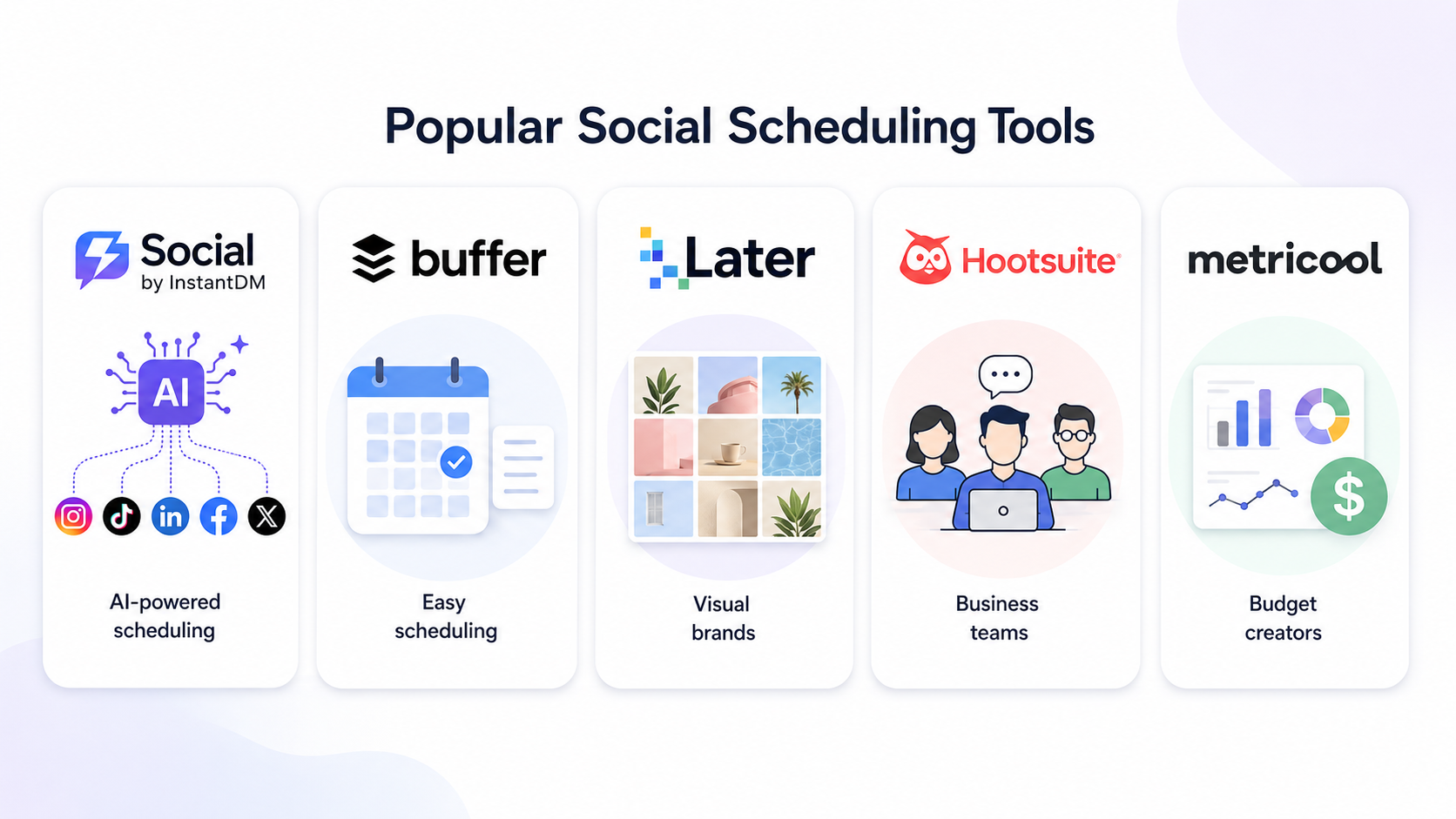
| Tool | Best For | Pricing | Platforms Supported | Free Plan |
|---|---|---|---|---|
| Social by InstantDM | AI-powered scheduling | Free plan | 8 platforms | Yes |
| Buffer | Easy scheduling | Free / $6 per month | 10 platforms | Yes |
| Later | Visual brands | Free / $25 per month | Limited | Yes |
| Hootsuite | Business teams | $99 per month | Limited | No |
| Metricool | Budget creators | Free / $22 per month | All platforms | Yes |
It depends on what you need the right tool for. If you want AI-powered scheduling with API access, Social by InstantDM is the most powerful option. Buffer is the winner if you want simplicity. Later, if you like, visual planning is the best choice.
Making your content pillar calendar
Making your content pillar calendar is the pitfall of most content strategies. You have good pillars, good ideas, but then Monday comes and you are rushing to post something before the day is done.
A content pillar calendar solves that. Here is the simplest form.
Week 1: Pillar 1 – Focus Write a blog post. Write two social posts. Write an email.
Week 2: Focus on Pillar 2 Same deal.
Week 3: Pillar 3 focus. Same story.
Week 4 Integrate all pillars Fill in gaps and experiment.
That gives every pillar attention, and keeps your content fresh. Adjust the ratio to your needs.
Here’s a daily rotation that really works, especially for social media:
Monday: Pillar 1 (educational blog post)
Tuesday: Pillar 2 (Case study or story)
Wednesday: Engagement Post (Poll, Question) – Pillar 3
Thursday: Pillar 1 (different format – reel or carousel)
Friday: Pillar 4 (promotional or BTS)
This helps keep your feed balanced while staying within your pillar framework.
Common Content Pillar Mistakes to Avoid
I’ve seen people screw this up in predictable ways. Here’s what to avoid.
To many columns. If you have seven or eight, you are not focusing. Select 3 to 5. Stay with them.
Pillars that are not in line with your business goals. Consulting services don’t typically benefit from a pillar on “funny memes” when you’re selling. Ensure your pillars genuinely support what you’re trying to sell.
Narrow columns, “Instagram Reels tips for Austin realtors”, is a piece of content, not a pillar. A column should be wider: “Instagram marketing for real estate.”
Too quick to change pillars. Give each pillar at least 3 months. Content strategy is a marathon. If you give up after 2 weeks because you didn’t go viral, you will never build anything.
Ignoring what works. If one pillar is consistently getting way more engagement than the others, give it more airtime. The data is trying to tell you something. Listen to that.
Omitting the measurement. If you don’t track performance by pillar, you’ll be unaware of what works and what doesn’t. You need data to know what is working and what is not.
Verifying that your pillars are actually doing the job
You need to know what works and what doesn’t. Here’s what to watch.
Pillar Engagement. Which pillar topics receive the most likes, comments, shares, and saves? This tells you what your audience really wants.
Reach of Pillar. Are some topics reaching more people? That’s the algorithm saying more of this yes
Follower growth by Pillar When you publish on certain pillars, do you get followers? Some topics draw in new people. And some only get to your existing audience.
Pillar Click-Throughs. If you’re driving traffic to your website, which content is getting clicks? This matters if you’re trying to sell anything.
Pillar conversions. What pillar topics generate sales or signups? That’s the metric that pays the bills
Record these things each month. After three months, you will have enough data to make smart decisions.

How AI is transforming the pillar game in 2026
AI tools are enabling content creation at an unprecedented pace. But most people get this wrong: they think AI replaces the strategy. Nope. “AI is good at executing. Terrible at deciding what to talk about.
Content pillars provide AI the direction it needs. That’s a good point! Instead of asking for a generic social media post, if you specify the context and platform, such as “write an Instagram carousel about Instagram algorithm tips for small business owners,” it will provide clear direction and improve the quality of the output. The context helps tailor the content more effectively.
You can connect AI agents through their MCP server with tools like Social by InstantDM. You tell it your pillar topic and the AI creates, schedules and posts content across platforms. The pillar takes care of the what. The tool takes care of the how.
This combo (strategic pillars + AI execution) is how the smartest creators are scaling without burning out in 2026.
Template: Content Pillar (Copy)
This is a simple template you can use right away.
Pillar name: [your topic of pillar]
Audience Problem [what problem to solve]
Content types: [blog, video, social, email?]
Content Ideas for Each Month: [list 8 to 10 specific ideas]
Key Metrics: [How will you measure success?]
Related Pillars: [what other pillars are connected to]
Complete this for each pillar You have a complete strategy.
Frequently asked questions (FAQs)
How many content pillars should I have? Three to five works best for most people. Fewer than three limits variety. More than five dilutes your focus. Start with 3 and add more only if you have the capacity to maintain them.
Can I change my pillars later? Sure. But give them at least three months first. Content strategy needs time to gain traction. Adjust based on data, not impulse.
Do content pillars work on all platforms? Yes. Blog, social media, email, YouTube, podcasts, ads — pillars work everywhere. You just change the format to fit the platform.
How do content pillars help with SEO? They build topical authority. When you consistently create content about the same topics, search engines start treating you as an expert. That improves rankings and makes you more likely to get cited in AI search results.
What’s the difference between a content pillar and a content calendar? The pillar is the what. The calendar is the when. You need both. The pillar gives you direction. The calendar gives you structure.
Bottom line:
Content pillars are the foundation of a content strategy that works. They kill decision fatigue, build authority and make content creation a lot more efficient.
It takes 20 minutes to set up. It gives back for months. Select 3-5 pillars that match your expertise and your audience’s needs. Start systematic development. What works. Measure.
If you want to take it a step further, tools such as Social by InstantDM can schedule and publish your pillar-based content across 8 platforms from one dashboard. The strategy is handled by the framework. The tool does the running of it.
Choose your columns. Start to make. The rest is history.
Frequently asked questions
How many content pillars should I have?
Three to five works best for most people. Fewer than three limits variety. More than five dilutes your focus. Start with 3 and add more only if you have the capacity to maintain them.
Can I change my pillars later?
Sure. But give them at least three months first. Content strategy needs time to gain traction. Adjust based on data, not impulse.
Do content pillars work on all platforms?
Yes. Blog, social media, email, YouTube, podcasts, ads — pillars work everywhere. You just change the format to fit the platform.
How do content pillars help with SEO?
They build topical authority. When you consistently create content about the same topics, search engines start treating you as an expert. That improves rankings and makes you more likely to get cited in AI search results.
What's the difference between a content pillar and a content calendar?
The pillar is the what. The calendar is the when. You need both. The pillar gives you direction. The calendar gives you structure.