Later Pricing Breakdown 2026: What Each Plan Actually Includes
Later costs $25-$110/month. Here's what you actually get, the hidden limits, and cheaper alternatives that might work better.
TL;DR
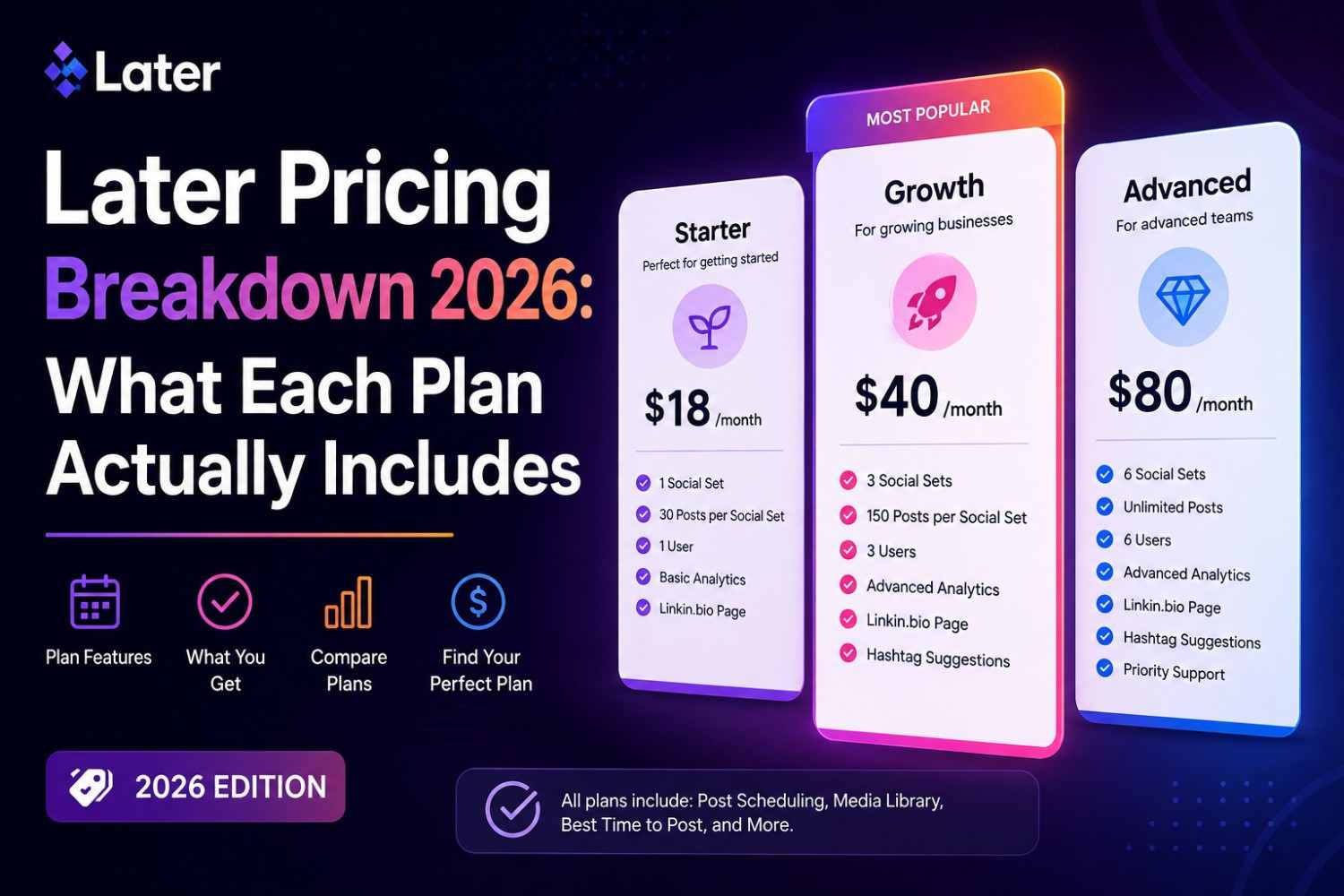
Later’s pricing in 2026 starts at $25 per month for the Starter plan and goes up to $110 per month for the Scale plan. One thing to know before signing up is that Later no longer has a permanent free plan. You only get a 14-day free trial, so if you want to keep using it after that, you’ll need to move to a paid plan.
The part that can get confusing is Later’s Social Set system. Instead of charging only for individual profiles, Later groups different social accounts together as a set. That works fine if you’re managing one brand, but the cost can climb pretty quickly once you start adding more brands, clients, or extra team members. It’s worth checking how many social sets you actually need before choosing a plan; otherwise, you may end up paying more than expected.
Later still makes sense for creators and brands that care about visual planning, scheduling, and managing content across multiple platforms. But if your main goal is simply to schedule a lot of content without paying a high monthly fee, there are cheaper options.
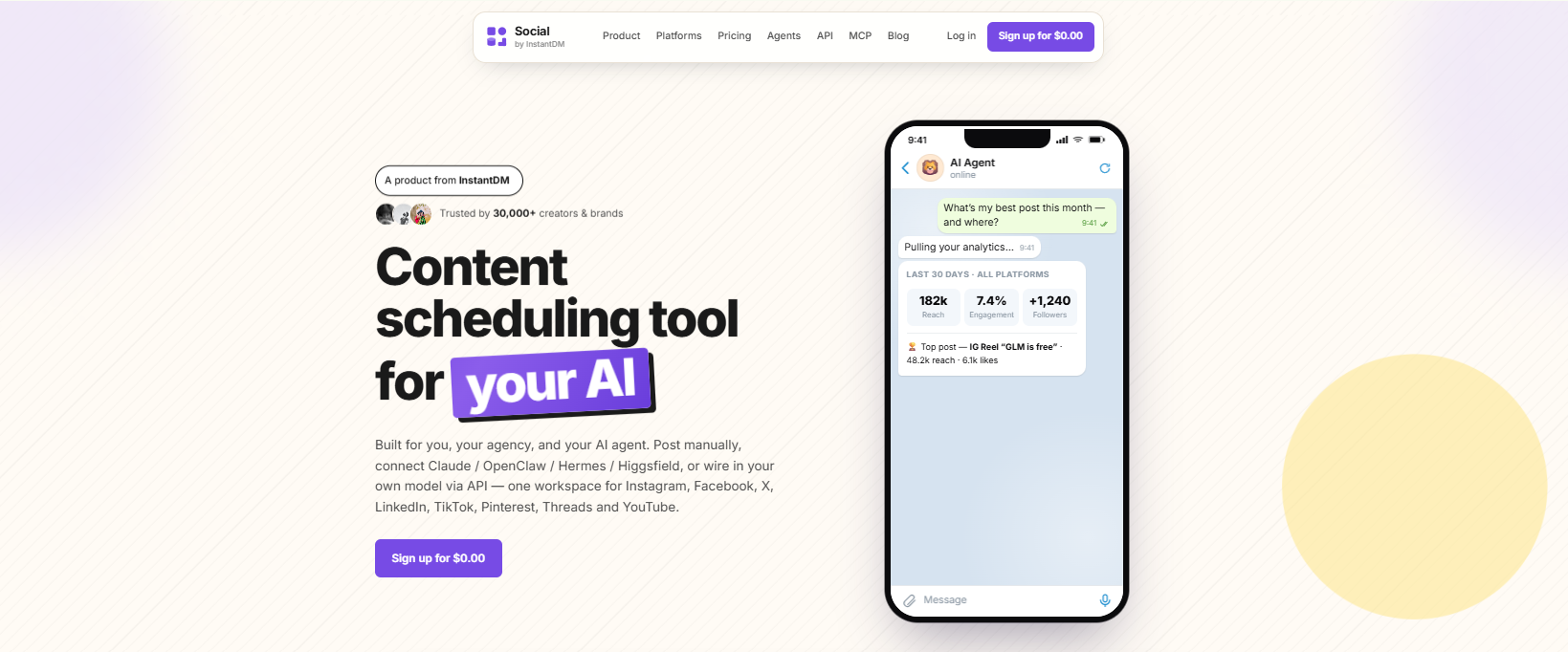
For example, Social by InstantDM (https://socialbyidm.com) offers a free plan with unlimited scheduled posts across 8 platforms, along with AI-powered scheduling features. So if Later feels expensive for your content volume, it’s worth comparing both before deciding.
Later pricing plans in 2026: quick breakdown
I’ll get straight to the numbers since that’s probably why you clicked. Later runs three paid plans now, and there’s no permanent free tier anymore.
The Starter plan runs $25 a month. It comes with one Social Set, which covers Instagram, Facebook, Threads, Pinterest, TikTok, LinkedIn, YouTube, and Snapchat all bundled together, plus 30 posts per profile each month, and a single user seat.
The Growth plan runs $45 a month. You get two Social Sets, unlimited posting, and still just one user. The analytics get noticeably deeper and you also get a batch of AI credits thrown in.
The Scale plan runs $110 a month. That gets you six Social Sets, unlimited posts, and room for three users. This is really the tier built for agencies juggling several clients at once.
That’s the official breakdown you’ll find on their pricing page. What it doesn’t spell out clearly is everything I’m about to walk through.
A few years back Later was one of the tools people pointed to as the affordable, friendly option for creators who just wanted their Instagram grid to look tidy. That reputation still lingers a bit, which is part of why I wanted to actually sit down and check whether the pricing still matches that reputation in 2026, or whether it’s quietly drifted upmarket while everyone kept recommending it out of habit.

What does each Later plan actually include?
Let me go through each tier properly, because the pricing page tends to gloss over some of this.
Starter, at $25 a month, gives you one Social Set, meaning one profile per platform, 30 posts per profile each month, one user seat, basic analytics, a link in bio page, a content calendar, and the Instagram grid preview tool.
Growth, at $45 a month, bumps you up to two Social Sets, removes the posting cap entirely, still limits you to one user, and adds more advanced analytics along with AI credits, the content calendar, grid preview, and suggestions for the best times to post.
Scale, at $110 a month, gives you six Social Sets, unlimited posting, room for three users, the same advanced analytics and AI credits, the calendar and grid preview, best time to post suggestions, and priority support on top of it all.
Taken individually, the features are genuinely decent. It’s really the pricing that starts to feel steep once you compare it against what else is out there.
What stood out to me while testing each tier is how much of the actual day to day usefulness lives in Growth rather than Starter. The grid preview and calendar look identical across all three plans on paper, but the moment you hit the 30 post ceiling on Starter, you’re effectively forced up a tier regardless of whether you actually need the second Social Set that comes bundled with it. That’s a detail the pricing page doesn’t really flag, and it changes the real cost of using Later meaningfully for anyone posting daily.
Does Later still have a free plan in 2026?
No, and this one surprised me a bit. Later doesn’t offer a permanent free plan anymore. What you get instead is a 14 day trial.
During that trial window you have access to everything in the Starter tier. Once the two weeks are up though, you either pay for a plan or you lose access entirely.
That’s a real shift from where things stood before. Back in 2025, Later still had a proper free plan with limited features that you could stick with indefinitely. That option is simply gone now.
The trial is fine if you just want to poke around and see if the interface suits you. But if you’re specifically hunting for something you can use for free long term, Later isn’t going to be it anymore. I ended up trying Social by InstantDM around this point, mainly because it still runs a genuine free plan with unlimited posts across eight platforms, no trial countdown attached to it.
I get why Later made this change from a business standpoint. Free plans cost real money to support at scale, and a lot of companies in this space have been quietly tightening their free tiers over the past couple of years rather than removing them outright the way Later did. Still, if you were on the fence about trying Later specifically because you’d heard it used to be free, it’s worth knowing upfront that those fourteen days are truly it. Set a reminder near the end of the trial so you’re not caught off guard by a charge, or so you can cancel cleanly if it’s not the right fit.

Later pricing by number of social profiles and users
This is where things get a little more confusing than they first appear, mostly because of how Later bundles platforms into what they call a Social Set.
One Social Set covers one profile per platform, and that’s across all eight platforms at once, Instagram, Facebook, Threads, Pinterest, TikTok, LinkedIn, YouTube, and Snapchat.
If you’re only running one brand across all eight of those, a single Social Set covers you completely. But the moment you’re managing a second brand, you need a second Social Set, and that pushes you straight from Starter up to Growth.
Here’s how it breaks down plan by plan.
| Plan | Social Sets | Users | Price |
|---|---|---|---|
| Starter | 1 | 1 | $25/month |
| Growth | 2 | 1 | $45/month |
| Scale | 6 | 3 | $110/month |
That jump from Starter to Growth is the one that catches people off guard. You only gain one extra Social Set, yet the price very nearly doubles. And if you’re handling three or more separate brands, Scale at $110 a month becomes your only real option within Later’s own tiers.
On top of the plans themselves, additional Social Sets cost $15 a month each if you need more than your plan includes, and extra user seats run $5 a month each. Those add on charges creep up faster than you’d expect if your team or client list grows even a little.
Say you’re on Growth managing two brands comfortably, and then a third client signs on. Rather than jumping straight to Scale at $110 a month, you could technically just add a third Social Set for an extra $15, bringing your total to $60 a month instead. That’s actually a smarter move than upgrading the whole plan if you don’t need the extra user seats or priority support that Scale bundles in. Worth doing this kind of math before you assume the next tier up is your only option.
Later’s hidden costs, limits, and upgrade triggers
The headline pricing looks clean enough, but there are a handful of catches worth knowing before you commit.
Starter’s post limit is the first one people run into. You’re capped at 30 posts per profile each month, and if you’re posting even once a day across a couple of platforms, you’ll blow past that pretty quickly.
The Social Set structure is its own trigger. Managing more than one brand means you’re either paying for add on sets or getting pushed up to a higher plan whether you wanted the rest of that plan’s features or not.
AI credits are limited too, even on the plans that include them. If you lean on the AI tools heavily for captions or ideas, you’ll likely burn through your allotment before the month is out.
There’s also a 15 percent discount for paying annually, which sounds appealing until you realize it means paying the full year upfront. Cancel partway through and you’re not getting that money back.
And of course, the biggest change overall is that there’s no free tier to fall back on anymore. Once your 14 day trial runs out, you’re either paying or you’ve lost access completely.
None of these are dealbreakers on their own, but stacked together they add up to more than the sticker price suggests. Worth knowing going in rather than discovering halfway through your first billing cycle.
One thing I’d genuinely recommend before signing up for anything is exporting a rough count of how many posts you actually publish in a normal month across all your platforms. Most people underestimate this until they see it written down, and it’s the single fastest way to tell whether Starter’s 30 post cap is going to be a real problem for you or a total non issue.

Which Later plan is best for creators, brands, and agencies?
Here’s roughly how I’d steer different types of users based on what I found.
If you’re a solo creator managing just one brand and posting less than once a day, Starter at $25 a month covers what you need, and the grid preview tool alone makes it worth considering if visual planning matters to you.
If you’re running a small business with one brand spread across several platforms and you need unlimited posting, Growth at $45 a month makes more sense, especially once you factor in the deeper analytics.
If you’re an agency managing multiple client accounts, Scale at $110 a month is really the only tier that fits, since the six social sets and three user seats line up with typical agency workloads.
If you’re working with a tight budget though, I’d honestly steer clear of Later altogether. Social by InstantDM has a genuinely free plan with unlimited posting across eight platforms, and Buffer starts as low as $6 per channel each month if you want something paid but cheaper.
There’s a middle case worth mentioning too, the growing creator who’s outgrown Starter but isn’t quite an agency yet. That’s usually someone posting daily across two or three platforms for a single brand, maybe starting to bring on a part time assistant. For that spot specifically, Growth tends to fit better than jumping straight to Scale, since the second user seat on Scale often goes unused while you’re still finding your footing with a small team.
Later pricing vs Buffer, Planoly, Metricool & other alternatives
Laying these out side by side made the comparison a lot clearer for me.
| Feature | Later | Buffer | Planoly | Metricool | Social by InstantDM |
|---|---|---|---|---|---|
| Price | $25/month | $6/channel/month | $16/month | $22/month | Free |
| Free Plan | No | Yes, 3 channels | Yes, 10 uploads | Yes, 1 brand | Yes, unlimited |
| Platforms | 8 | 10+ | Limited | All | 8 |
| AI Features | Limited | Limited | Limited | Limited | Yes |
| Grid Preview | Yes | Basic | Excellent | Basic | Good |
Later sits above Buffer, Planoly, and Metricool on price, though it does come in cheaper than Hootsuite, just with fewer bells and whistles than Hootsuite offers.
If AI powered scheduling is what you’re after specifically, Social by InstantDM ended up standing out to me the most, mainly because of the free plan, the eight platform coverage, and the AI agent features baked in without an extra charge.
It’s also worth thinking about platform coverage separately from price. Buffer technically supports more platforms than Later does, which matters if you’re active somewhere like Mastodon or Google Business Profile that Later simply doesn’t touch. Metricool leans harder into analytics than any of the others on this list, which makes it a better pick if reporting is more important to you than posting volume. And Planoly, while narrower in scope, still beats Later on the grid preview experience specifically, since that’s really all Planoly was built to do from the start.

Is Later worth $25+ per month in 2026?
This is really the question underneath everything else, and my honest answer is that it depends on what you’re actually using it for.
If Instagram grid planning and visual scheduling are your main priority, then yes, Later earns its price. The grid preview genuinely is well built, and having a link in bio page included saves you from paying for a separate tool just for that.
If what you actually need is broad multi platform scheduling though, Later starts to feel overpriced fast. You can get more functionality for less money through alternatives like Buffer, Metricool, or Social by InstantDM.
And if you’re simply working with a limited budget, Later probably isn’t your best fit. There are free alternatives out there that cover the basics just fine without costing you anything.
The real key is being honest with yourself about what you’ll actually use. Paying for six Social Sets and priority support when you manage one brand and post twice a week is money left on the table.
I’d also add that pricing shouldn’t be evaluated in isolation from how much time a tool actually saves you. If Later’s grid preview means you spend twenty fewer minutes each week second guessing how your feed looks before you post, that’s a real value even if a cheaper tool technically covers more platforms on paper. The right question isn’t just what’s cheapest, it’s what’s cheapest for the specific problem you’re trying to solve.
Cheaper and free alternatives to Later
If your budget is the deciding factor, here’s what I’d look at instead.
Buffer, at $6 per channel each month, is about as simple as scheduling tools get. Clean interface, pricing that’s easy to understand at a glance, and a free plan that covers three channels if you want to test it first. If all you want is straightforward scheduling without extra frills, Buffer is the cheapest paid route.
Metricool, at $22 a month, sits in the middle as a solid budget pick. Its free plan covers one brand across every platform it supports, and the analytics hold up reasonably well for the price. If you’re watching your spending closely, Metricool offers good value.
Social by InstantDM, which I keep coming back to, has a free plan that includes unlimited scheduled posts, coverage across eight platforms, and AI agent integration built right in. If you want AI features without paying a cent, this option is the one I’d point people toward.
Planoly, at $16 a month, focuses specifically on Instagram grid planning and includes a free plan with 10 uploads. If Instagram is genuinely your only platform, Planoly ends up cheaper than Later while doing the grid planning piece just as well, arguably better in some ways.
Meta Business Suite costs nothing at all and comes built directly into the platform. If your needs stop at Instagram and Facebook, there’s honestly no cheaper option than free.
I’d suggest actually trialing two of these side by side rather than picking based on a comparison chart alone, mine included. Numbers on a page only tell you so much, and the tool that ends up sticking is usually the one whose interface just clicks with how you naturally think about planning content, not necessarily the one with the longest feature list.
Frequently asked questions
How much does Later cost in 2026? Later’s pricing runs from $25 a month on Starter up to $110 a month on Scale. There’s no permanent free plan left, just a 14 day trial.
Does Later have a free plan? No. That option was removed, and what remains is a two week trial rather than an ongoing free tier.
What is a Social Set on Later? It’s a bundle covering one profile from each of Later’s eight supported platforms, meaning Instagram, Facebook, Threads, Pinterest, TikTok, LinkedIn, YouTube, and Snapchat all counted as a single set.
Is Later better than Buffer? It really depends on what you need. Later pulls ahead for Instagram grid planning specifically. Buffer wins on price and simplicity. And if AI features on a free plan matter to you, Social by InstantDM covers that gap neither of the other two fills.
What’s the cheapest alternative to Later? Social by InstantDM offers a free plan with unlimited posts across eight platforms. Buffer starts at $6 per channel monthly. And Meta Business Suite is free outright if you only need Instagram and Facebook.
Can I switch plans mid month if my needs change? Yes, Later lets you upgrade or downgrade between tiers at any point, though downgrading typically takes effect at the start of your next billing cycle rather than immediately, so keep that timing in mind if you’re trying to avoid an extra charge.
Do unused posts roll over on the Starter plan? No, the 30 post allowance resets each month and any posts you didn’t use simply don’t carry forward, which is another reason that cap catches people off guard if their posting frequency varies month to month.
The bottom line
Later works well for creators who are Instagram focused and genuinely care about how their grid looks. The visual planning tools are built thoughtfully and it shows.
That said, the pricing has gotten steep for what you actually walk away with. The free plan is gone entirely, the Social Set bundling can catch you off guard the moment you manage more than one brand, and there are cheaper tools out there that cover more ground.
If grid planning specifically is your priority, $25 a month for Later is a reasonable trade. If you need broader multi platform coverage or AI features without the price tag, alternatives like Buffer, Metricool, or Social by InstantDM are worth a real look before you commit.
Don’t pay for features that sit unused. Run the free trials and free plans first, and pick whichever tool actually fits how you work day to day.
At the end of it all, pricing pages rarely tell the full story, and Later’s is a good example of that. The number you see up front is only part of what you’ll actually pay once Social Sets, add on seats, and AI credit limits enter the picture. Spend the twenty minutes it takes to map your actual posting habits against each plan before you commit, and you’ll avoid the upgrade surprise that a lot of people run into a few months in.